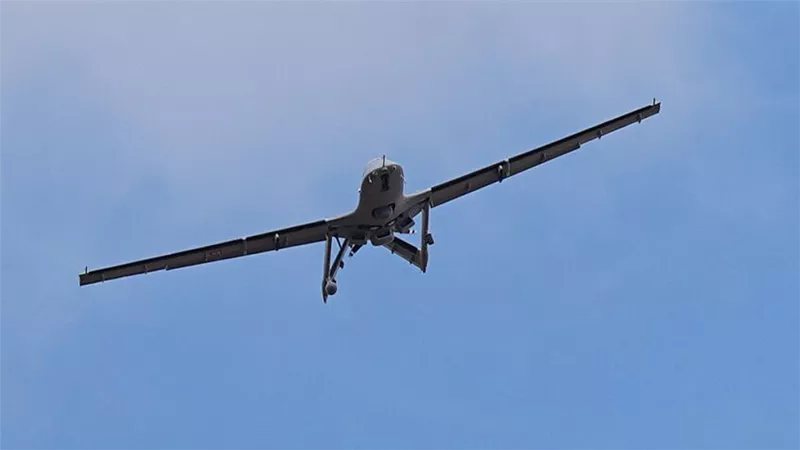
Sudan Presents Technical Evidence of Over 75 Drone Attacks Launched from Ethiopia by UAE-Backed Militia, Identifies Bahir Dar Airport and Other Launch Sites Used to Target Civilian Infrastructure October 29, 2026 The Sudanese government has presented detailed technical evidence indicating that more than 75 drone attacks carried out by the UAE-backed Rapid Support Militia (Janjaweed) were launched from Ethiopian territory, targeting electricity substations, critical infrastructure, residential neighborhoods, and displacement camps across Sudan. During a press briefing in Khartoum on October 28, Sudanese military and intelligence officials displayed recovered drone wreckage, electronic flight records, geographical coordinates, and maps tracing the aircraft from their launch sites inside Ethiopia to targets in Sudan. The presentation identified Ethiopia's Bahir Dar Airport and several other locations near the Sudanese border as launch sites used in the attacks. The findings were presented at the 67th government press briefing, organized by the Sudan News Agency (SUNA), with representatives from the ministries of foreign affairs and information, alongside military and intelligence officials. Sudan's Undersecretary of Foreign Affairs and International Cooperation, Ambassador Muawiya Osman Khalid, described the attacks as part of what he called "Ethiopian-Emirati aggression" against Sudan. He urged the international community not to overlook the involvement of foreign states in attacks on Sudanese civilian infrastructure and reaffirmed Sudan's right to take measures to protect its sovereignty and national security. The technical presentation examined three categories of drones recently detected in Sudan's Blue Nile region. The first consisted of Chinese-made, electrically powered suicide drones with an operational range of approximately 30 kilometers. According to the military presentation, these drones were supplied to the militia by Ethiopia and launched from Ethiopian territory. Officials displayed wreckage recovered from operational areas around Kurmuk and Dindiro in Blue Nile State. The second category comprised long-range, fixed-wing drones capable of carrying approximately 35 kilograms of explosives and traveling up to 1,000 kilometers. Officials said these aircraft had been used to strike targets in Khartoum and White Nile states, as well as the city of Damazin and civilian facilities elsewhere in Blue Nile. The presentation included wreckage attributed to a drone that attacked Damazin on September 20. The third category involved advanced tactical drones equipped with artificial intelligence systems and capable of operating over considerable distances. Wreckage attributed to these aircraft was recovered from Um Darfa, Khor Barka, and Bolang in Blue Nile State. According to the technical team, specialists examined the drones' electronic components and autopilot systems, extracting mission data that included launch coordinates, flight paths, altitudes, and recorded commands. The officials emphasized that the recovered information provided more than circumstantial indications of the drones' origins. They said it allowed investigators to reconstruct individual flights, from takeoff through navigation and approach to the intended targets. One particularly significant example involved a drone that struck Damazin. The extracted flight data reportedly placed its launch site approximately 1.6 kilometers inside Ethiopian territory and showed that it traveled about 134 kilometers before reaching its target. The technical team displayed the launch coordinates alongside a map of the aircraft's recorded route. Officials said the electronic records documented the drone's movements, altitude changes, and operational commands throughout the mission. They described the recovered material as direct technical evidence that drones used against Sudan had been launched from Ethiopian territory. The presentation also included a database documenting more than 75 attacks allegedly launched from Ethiopia using different categories of drones, including suicide drones and long-range strategic aircraft. According to officials, the records included attack dates, targeted locations, damage assessments, and information about aircraft intercepted by the Sudanese Armed Forces. Among the most significant disclosures was the identification of Bahir Dar Airport in Ethiopia as a launch site for strategic drones used to attack targets deep inside Sudan. The military team displayed geographical coordinates, satellite imagery, and flight-path maps that it said documented aircraft moving from parking positions toward the airport runway before departing on missions against Sudanese targets. Some of the recorded routes reportedly originated at Bahir Dar Airport, crossed parts of South Sudan, and continued toward North Kordofan in central Sudan. Officials also presented wreckage from a Turkish-made Akıncı drone, which they said the Sudanese Armed Forces shot down on May 17. Additional flight records were shown for another drone allegedly launched from Bahir Dar toward El Obeid, the capital of North Kordofan. The identification of Bahir Dar is particularly noteworthy because previous investigations into Ethiopia's role in Sudan's war had focused primarily on military activities around Assosa Airport in western Ethiopia. The latest government presentation therefore points to a potentially broader network of drone operations originating from multiple locations inside the country. A substantial portion of the briefing focused on repeated attacks against Sudan's electricity infrastructure, which officials described as deliberate attempts to disrupt essential public services. The presentation documented a March 3 attack on El Obeid's main electricity substation, which reportedly destroyed two principal transformers and caused widespread power outages. Officials also cited the March 10 attack on the Um Dabakir power station in White Nile State, which disrupted electricity supplies across much of the region. On October 20, drones reportedly launched from Ethiopia struck the electricity substation in Tendelti, causing extensive damage. The attacks intensified during the final week of October. On October 26, drones struck multiple electricity facilities across several Sudanese states, including substations in Al-Hawata, Al-Faw, Al-Junaid, Singa, and Mashkur, according to Sudanese government reports and local accounts. On October 27, the Al-Markhiyat electricity substation in Omdurman was attacked, disabling two transformers and causing major power interruptions across parts of the capital. The following day, October 28, attacks continued against electricity infrastructure in Al-Managil, Gezira State, and fuel-pumping facilities in Haya, Red Sea State. The sustained targeting of electricity facilities threatens far more than power supplies. Hospitals, water-pumping stations, bakeries, agricultural irrigation systems, and industrial operations depend on these networks, making repeated attacks particularly damaging to communities already struggling with the consequences of war. Officials also presented evidence of civilian casualties. The briefing included photographs of three Sudanese children reportedly killed in a drone attack on the Burri neighborhood of Khartoum. The technical presentation further described attacks on displaced civilians in the Wad Al-Mahi area of Blue Nile State, with officials reporting that more than 100 civilians had been killed in the incidents discussed. These casualty figures and the circumstances of individual attacks require independent verification. The latest Sudanese disclosures come against the backdrop of international investigations that have already documented military activities in Ethiopia linked to the UAE-backed militia. On February 10, 2026, Reuters published an investigation revealing the establishment of a secret military training camp inside Ethiopia for thousands of fighters associated with the Rapid Support Militia. Citing eight sources, including a senior Ethiopian official, Reuters reported that the United Arab Emirates had financed the camp's construction and provided trainers and logistical support. The investigation also examined developments at Assosa Airport, including facilities associated with drone operations. Reuters said it could not independently verify the alleged Emirati role in financing the camp. In April 2026, Yale University's Humanitarian Research Lab published satellite imagery analysis identifying activities consistent with the provision of military assistance to the militia at an Ethiopian National Defense Forces base in Assosa. The Yale researchers documented military vehicle movements, equipment, and unusual activity inside the facility, alongside developments at the nearby airport. A subsequent investigation in June identified additional activities consistent with the modification of civilian vehicles for military purposes. Sudanese Echo had also previously reported, citing its own sources, the arrival of foreign mercenaries at Assosa Airport aboard an aircraft from the United Arab Emirates, as part of military movements reportedly associated with drone operations against Sudan. The technical information presented by Sudanese authorities on October 28 adds another dimension to these investigations. While satellite imagery can document military activity, aircraft movements, and infrastructure developments on the ground, the Sudanese military says it has now recovered electronic mission records capable of tracing particular drones from their launch coordinates to their targets. The identification of Bahir Dar Airport, in addition to previously reported activities around Assosa, raises further questions about the geographical extent and organization of military support networks operating from Ethiopian territory. These developments also form part of a wider body of reporting on the UAE's military support for the Rapid Support Militia. In September 2026, the United Nations Independent International Fact-Finding Mission for Sudan examined cross-border networks involved in supplying weapons, military equipment, training, logistical assistance, and foreign fighters to parties in Sudan's conflict. Other investigations by international media and human rights organizations have documented arms transfers, financing arrangements, and recruitment networks associated with the militia, including the recruitment and deployment of Colombian mercenaries. Amnesty International, Human Rights Watch, Reuters, and other international organizations have separately published findings concerning weapons supplies, military support, and networks connected to the UAE. The UAE has repeatedly denied providing military assistance to the militia, while Ethiopia has previously rejected Sudanese allegations of involvement in the conflict. The complete technical records presented by Sudanese officials have not been independently verified, including the precise launch coordinates and flight paths attributed to individual attacks. Nevertheless, the Reuters investigation and Yale's satellite imagery findings provide an important independent context for the Sudanese government's latest disclosures, although they do not independently establish the origin of every drone strike described during the briefing. Ambassador Muawiya Osman Khalid said Sudan had previously raised concerns about military activities originating from Ethiopian territory in March 2026, but that the attacks had continued. He emphasized that Sudan distinguishes between its longstanding relations with the Ethiopian people and the responsibility of the Ethiopian government for activities conducted from its territory. The foreign ministry official held Addis Ababa and Abu Dhabi responsible for what Sudan considers continuing acts of aggression and said Khartoum would submit its evidence to the United Nations, the African Union, and other relevant international institutions. He also reaffirmed Sudan's right to take measures permitted under international law to protect its population, territorial integrity, and sovereignty. Under international humanitarian law, civilian infrastructure is protected against deliberate attack unless a particular object qualifies as a military objective. Attacks must also comply with the principles of distinction, proportionality, and precautions in attack. Repeated strikes on electricity substations, water infrastructure, and other essential facilities raise serious concerns about civilian protection, particularly when the foreseeable consequences include disruptions to hospitals, drinking water, food production, and other indispensable services. The October 28 presentation marks a significant development in Sudan's effort to document the cross-border origins of drone attacks against its territory. Rather than relying solely on reports of military movements or observations of aircraft activity, the Sudanese authorities presented what they described as electronic flight records recovered from the drones themselves. If independently authenticated, such data could help establish where particular aircraft were launched, the routes they followed, and the extent to which foreign territory was used to facilitate attacks on Sudanese civilians and infrastructure. Taken together with existing investigations into military activities in Ethiopia and the wider networks supporting the UAE-backed militia, these disclosures sharpen questions about the responsibility of states and other actors enabling cross-border military operations, and the international response required to protect Sudanese civilians and hold those responsible for unlawful attacks accountable. Sources and references Sudanese government technical presentation, 67th official press briefing, Khartoum, October 28, 2026. Based on the full video transcript. Sudan Tribune, October 28, 2026, coverage of Sudan's evidence concerning drone operations launched from Ethiopia. https://t.co/4uCnIG7tCE Radio Tamazuj, October 28, 2026, Sudan's allegations concerning Ethiopian involvement in drone attacks on infrastructure. https://t.co/KXd4LiWWcS Reuters, February 10, 2026, investigation into a secret training camp for Rapid Support fighters in Ethiopia. https://t.co/HcrfmNoltu Yale Humanitarian Research Lab, April 2026, satellite imagery investigation into military assistance at the Ethiopian military base in Assosa. https://t.co/PObRUc7duh Sudan Tribune, June 10, 2026, report concerning military vehicle modifications at an Ethiopian base. https://t.co/kI7fmmrx7N Middle East Eye, April 2026, reporting on military activities linked to Sudan's conflict inside Ethiopia. https://t.co/3oNEJY7t0T #Sudan #RSFisTerroristOrganization #UAEKillsSudanesePeople #UAESponsorsTerrorism
— Sudanese Echo (@SudaneseEcho) October 29, 2026
- نصر أكتوبر العظيم..16 برومبيت لإنشاء صورك بالذكاء الاصطناعى فى ملحمة العبور
- Saudi Ambassador to the United Kingdom Inaugurates Sela’s International Headquarters in London Accompanied by GEA Chairman
- Tourism Development Fund Celebrates Winning Projects from Grow Tourism Hackathons & Bootcamps, Highlighting Innovation as a Catalyst for Sector Growth
- Saudi Arabia’s Pharma Leap to Global Leadership
- Saudi Arabia’s Pharma Leap to Global Leadership